TradingKey - In August 2026, the U.S. software sector significantly outperformed the broader market. The iShares Expanded Tech-Software Sector ETF (IGV) rose more than 16%, marking its second-best monthly performance since 2002, while the S&P 500 Index gained about 2.6% over the same period.
What Is the Software Sector?
The US software sector covers fields such as cloud computing, enterprise management, cybersecurity, and data analytics. Most companies generate recurring revenue through subscriptions or long-term contracts, making the sector a key gateway for enterprise AI deployment.
At the beginning of the year, the market worried that generative AI would replace traditional software features and disrupt the per-seat pricing model of SaaS companies. As multiple companies disclose AI contracts, revenue, and usage data, market focus has shifted to whether AI can drive order growth, expand customer purchases, and generate sustained revenue.
Below are several noteworthy software-concept stocks in the US market:
Comparison Item | PLTR | CRM | NOW | SNOW |
Primary AI Focus | Data Analytics & Decision-Making | Sales, Customer Service & Marketing Agents | Enterprise Workflow Automation | Data Platform & AI Development |
Core Products | AIP | Agentforce, Data 360 | Now Assist, AI Agents | Cortex AI, CoCo, CoWork |
Latest Quarterly Revenue | $1.935 billion | $11.345 billion | $3.987 billion | $1.547 billion |
Revenue Growth Rate | 93% | 11% | 24% | 35% |
Disclosed AI Metrics | AIP revenue not disclosed separately | Agentforce ARR exceeds $1.5 billion | AI business ACV exceeds $1 billion | AI revenue not disclosed separately |
Key Observations | Commercial customer growth, AIP contribution | ARR conversion, growth rate of legacy business | AI contract conversion | Product revenue, customer usage volume |
Key Risks | High valuation, timing of government contracts | Reporting methodology, impact of M&A | Contract conversion, valuation | Usage volatility, GAAP losses |
Palantir: Revenue Growth Leads, AIP Contribution Still Not Separately Disclosed
Palantir's second-quarter revenue came in at $1.935 billion, up 93% year-over-year. Among this, U.S. commercial revenue grew 149% to $764 million, while U.S. government revenue increased 90% to $809 million. The company raised its 2026 revenue guidance to between $8.150 billion and $8.158 billion.
Palantir attributed the growth of its U.S. commercial business to the expanding adoption of AIP. The platform helps enterprises connect large models to internal data, permission systems, and business processes, and the company has not yet disclosed standalone AIP revenue.
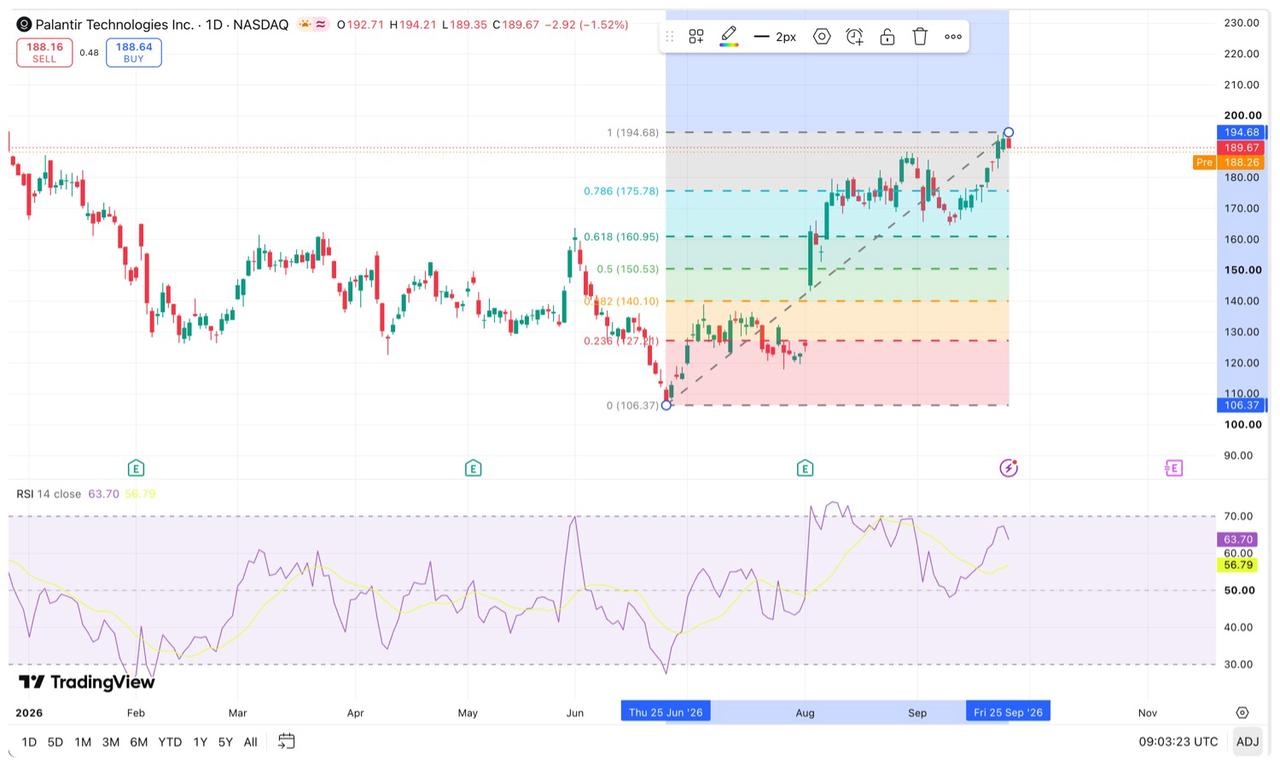
On the technical front, calculated from the June 25 low of $106.37 to the September 24 high of $194.68, key Fibonacci levels are as follows:
[Source: TradingView]
As of September 25, PLTR closed at $189.67, remaining in the upper zone of this medium-term uptrend. To the upside, the first level to watch is $194.68; if it breaks out on high volume and holds, the stock may test its all-time high of $207.52, with a further target at the 1.272 extension level of $218.70.
On the downside, $183–$188 represents recent price structure support rather than a standard Fibonacci level. If this area fails to hold, the next key support is the 0.236 retracement level at $173.84; below that, $160.95 and $150.53 are the subsequent levels to watch. Holding above $194.68 will maintain the upward structure, while a break below $173.84 would signal a significant weakening of medium-term rally momentum.
Salesforce: Agentforce ARR Surpasses $1.5 Billion
Salesforce reported second-quarter fiscal 2027 revenue of $11.345 billion, up 11% year-over-year, with Informatica contributing $456 million; subscription and support revenue grew 12% to $10.820 billion.
Agentforce ARR exceeded $1.5 billion, and combined ARR with Data 360 approached $3.9 billion. Starting this quarter, Agentforce ARR includes other AI products, Slackbot, and Headless 360, so its year-over-year growth rate is not on an entirely comparable basis with previous data.
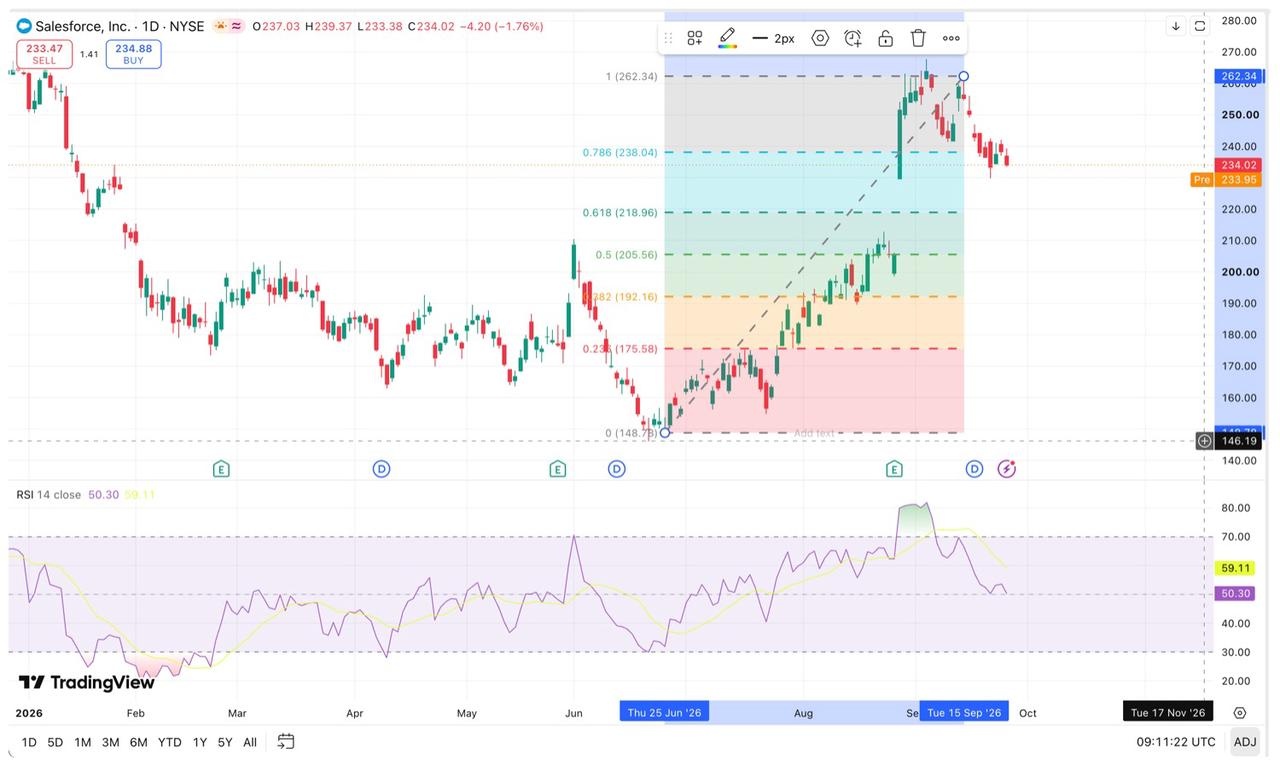
As of September 25, CRM closed at $234.02, below its 5-day, 10-day, 20-day, and 50-day moving averages, with a 14-day RSI of approximately 37, indicating weak short-term momentum.
Based on the move from the June 25 low of $148.78 to the September 15 high of $262.34, $238.04 represents the 0.236 Fibonacci retracement level. If the stock reclaims and holds above this level, attention could turn to $242–$244, with a further breakout potentially testing $262.34.
On the downside, $230–$232 is the primary support. If broken, the stock may successively retest $226 and $218.95, with $218.96 corresponding to the 0.382 retracement level.
[Source: TradingView]
ServiceNow: AI Business ACV Tops $1 Billion
ServiceNow's second-quarter subscription revenue reached $3.877 billion, up 24.5% year-over-year, while total revenue grew 24% to $3.987 billion. The annual contract value (ACV) of its AI business exceeded $1 billion, providing a contractual foundation for future revenue growth.
During the quarter, the company signed 123 deals with net new ACV exceeding $1 million, up nearly 40% year-over-year; ServiceNow AI agent deployments grew 9-fold within nine months. Going forward, the focus will be on the speed of AI contract conversions and additional purchases from existing customers.
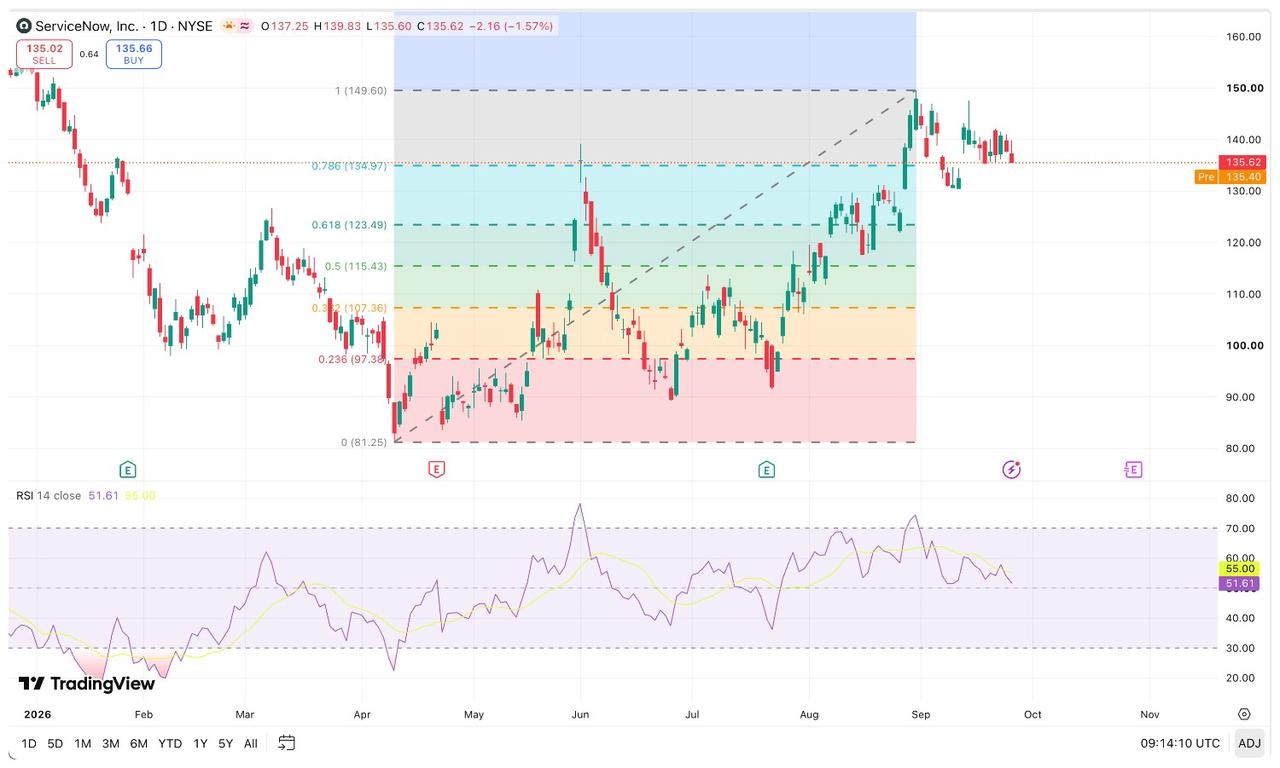
As of September 25, NOW closed at $135.62, below some of its short-term moving averages; the 14-day RSI was approximately 51.61, placing momentum in neutral territory.
Calculated from the April low of $81.24 to the August 31 high of $149.60, $134.97 represents the 0.236 Fibonacci retracement level. If the stock holds this position, attention could turn to $138–$143; a further breakout could retest $149.60.
To the downside, $130–$133 serves as the primary support zone. If breached, the next key support lies at $123.49, corresponding to the 0.382 retracement level. Holding firm above $143 would help improve the short-term outlook, whereas a drop below $130 could intensify pull-back pressures.
[Source: TradingView]
Snowflake: AI Applications Drive Data Usage Growth
Snowflake's fiscal 2027 second-quarter product revenue was $1.492 billion, up 37% year-over-year, while total revenue grew 35% to $1.547 billion. Remaining performance obligations increased 30% to $9 billion, with a net revenue retention rate of 126%.
During the final four weeks of the quarter, CoCo averaged over 9,100 weekly active accounts, up by more than 2,000 during the quarter, while CoWork reached 5,800 average weekly active accounts. These figures reflect product adoption breadth and do not represent paying customer counts or standalone AI revenue. AI adoption increases compute, storage, and data transfer demands, helping to drive usage-based product revenue growth.
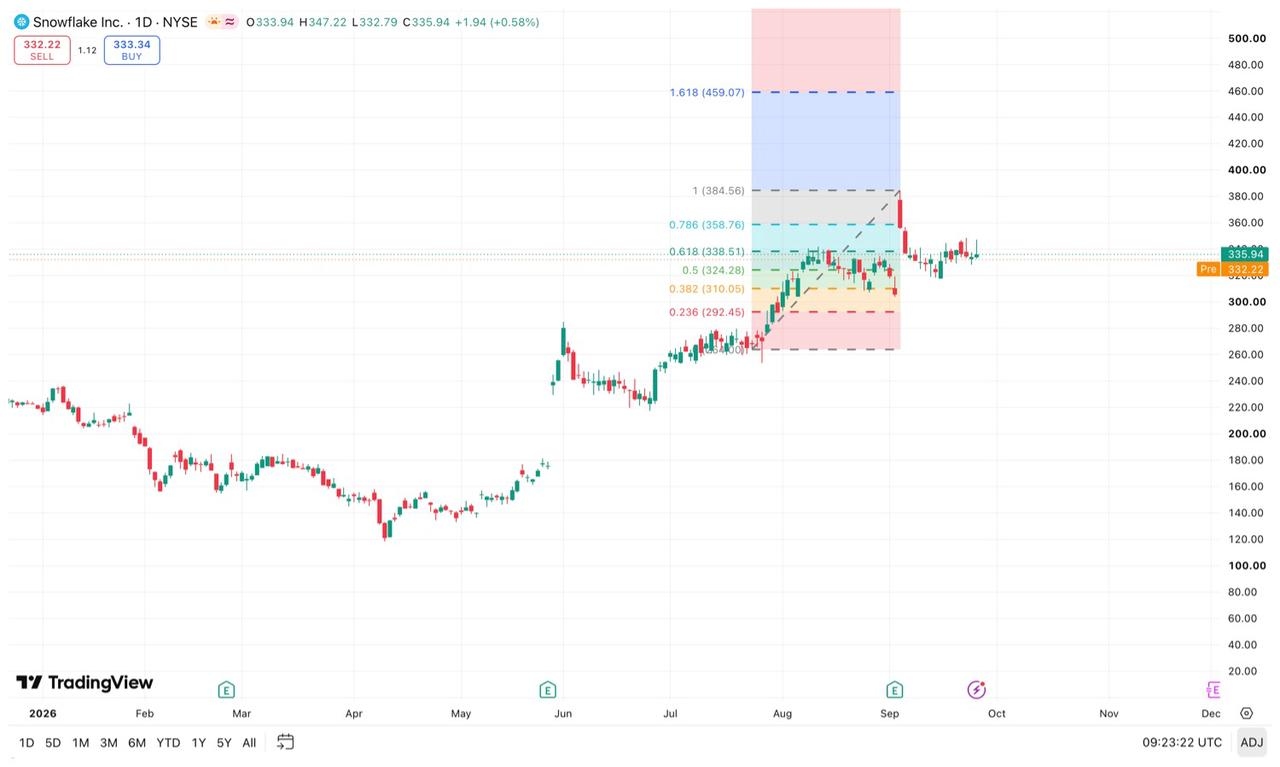
As of September 25, SNOW closed at $335.94, with the 14-day RSI at approximately 55, placing short-term momentum in neutral territory.
Based on the move from the July 24 low of $264 to the September 3 high of $384.56, $338.51 represents the 0.382 Fibonacci retracement level. If the stock reclaims and holds above this level, upside targets to watch include $345-$347 and $356-$359, where $356.11 corresponds to the 0.236 retracement level; a further break higher could lead to a retest of $384.56.
On the downside, $324-$330 is the primary support zone, with $324.28 corresponding to the 0.500 retracement level. If broken, the next key support lies at $310.05, representing the 0.618 retracement level.
[Source: TradingView]
PLTR, CRM, NOW, SNOW: How to Choose Among Four AI Software Stocks?
PLTR boasts the highest revenue growth rate, with its US commercial business delivering an outstanding performance, though the company has yet to separately disclose AIP revenue. A higher valuation also means the market expects more in terms of subsequent growth and profitability.
CRM has the largest revenue scale, with Agentforce ARR providing a relatively clear metric for AI commercialization. Its future performance depends on the conversion of ARR into recognized revenue, the growth rate of its legacy business, and the integration of Informatica.
NOW's AI business ACV has exceeded $1 billion, as IT services, customer service, and security workflows provide enterprise application scenarios for AI Agents. Whether AI contracts can be converted into subscription revenue on schedule is the key metric to observe in the next phase.
SNOW's product revenue is growing rapidly, with expanding AI applications expected to boost compute, storage, and data transfer usage. Consumption-based billing also leaves quarterly revenue more susceptible to the pace of customer usage.
Investors prioritizing growth can focus on PLTR; those valuing business scale and AI revenue visibility can look at CRM; those bullish on enterprise workflows can evaluate NOW; and those favoring AI data demand can consider SNOW. The final choice should still incorporate valuation, profitability, and cash flow.
Find out more